Page 1 of 2
shiny, glossy, glassy, bright, polished, gleamin
Posted: Fri Apr 08, 2011 5:22 am
by mariner
Just received some new boat bling! I can now start re-bedding all of the rail hardware, I found these ss parts on line for a great price so i decided to switch the old corroded chromed pot metal to solid ss.

box of new ss parts
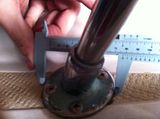
old and corroded, was thinking of removing and re plating, but new ss is less expensive.
Posted: Fri Apr 08, 2011 6:23 am
by John K
Nice boat jewelry! Do the holes match up?
Posted: Fri Apr 08, 2011 6:52 am
by mcrandall
Oooooo! Where'd you get it from?
What do you guys prefer to use to fill holes when re-doing them?
Posted: Fri Apr 08, 2011 8:11 am
by mariner
some of the holes look like they match others do not (the vertical strait ones) either way it does not matter to me as i was planning on over drilling and filling with epoxy, then redrilling the correct size hole and installing SS backing plates, I will now have plates made and drilled to match the new stancheons. I got them from here:
http://www.surplusunlimited.com/

this is one of the vertical stancheons that is cracking, the new one is way nicer...

New one!
Posted: Fri Apr 08, 2011 9:22 am
by Bhacurly
COOOL!
Posted: Fri Apr 08, 2011 10:28 am
by lecker68
Great looking parts.
Posted: Fri Apr 08, 2011 12:38 pm
by LeatherneckPA
I had the idea of installing backing plates also. But my reason was a little different. I was thinking that if I used SS fittings and stanchions with backing plates I might be able to bring them up to a 36" height so that they might actually serve some purpose. With a little netting strung between them they would serve to keep my Airedale on board, and maybe even my grandson.
Posted: Fri Apr 08, 2011 1:18 pm
by Alanhod
A collective... OOOH, aaaahhhh, was heard across the forum. A universal tiny pang of jealousy was experienced by all who beheld the gems neseled in packing peanuts. And a Yea Baby! was uttered.
Very nicely done, and they are not even installed yet. Cant wait to see those photos with them installed.
Thanks
Alan
Posted: Fri Apr 08, 2011 3:36 pm
by mariner
LeatherneckPA wrote:I had the idea of installing backing plates also. But my reason was a little different. I was thinking that if I used SS fittings and stanchions with backing plates I might be able to bring them up to a 36" height so that they might actually serve some purpose. With a little netting strung between them they would serve to keep my Airedale on board, and maybe even my grandson.
I was thinking the same thing, the first task is getting the bases installed - new tubes and life lines and perhaps netting is for later...
Posted: Fri Apr 08, 2011 3:37 pm
by mariner
Alanhod wrote:A collective... OOOH, aaaahhhh, was heard across the forum. A universal tiny pang of jealousy was experienced by all who beheld the gems neseled in packing peanuts. And a Yea Baby! was uttered.
Very nicely done, and they are not even installed yet. Cant wait to see those photos with them installed.
Thanks
Alan
Alan, you are too funny, I'll have a dram in your honor tonight!

Posted: Fri Apr 08, 2011 6:19 pm
by sauerleigh
As desirable as a 36" tall stanchion might be it is probably not a good idea. It will bend more than a 24" stanchion of the same material and wall thickness at the same load. A ran a test in Solid Works on 300 series SS tube, 1" OD with .120" wall for both lengths. With the base anchored, pushing at the top of the tube with 100#, 200# and 300# and the longer tube always deflects more. Even at 100# the test does not show a safety factor of 1 for a 24" tube which means the tube will deflect.
Posted: Sat Apr 09, 2011 6:56 am
by LeatherneckPA
OK, how about swapping the tube out with solid SS bar?
Posted: Sat Apr 09, 2011 7:14 am
by mariner
LeatherneckPA wrote:OK, how about swapping the tube out with solid SS bar?
Nice! I'm planning on leaving the height alone, I have always viewed these as "indicators of where the boat ends" and not guard rails. That's the first thing I tell anyone who I sail with that doesn't know anything about boats!
Posted: Sat Apr 09, 2011 7:36 am
by mcrandall
I have always viewed these as "indicators of where the boat ends" and not guard rails.
Too funny Mariner! I assumed they were there to help assure you hit the water closer to head-first, rather than feet-first.

Posted: Mon Apr 11, 2011 2:45 am
by mariner
mariner wrote:
this is one of the vertical stancheons that is cracking, the new one is way nicer...
New one!
So here is my million dollar question, as you can see the deck is not flat or smooth as the base of the stanchion is. So what is the best way to create a full contact surface, without permanently "bedding" the bases? I was thinking of getting some type of rubber or gasket material and cutting to shape, so when compressed it would create a solid base? Any thoughts on how best to install these, other than goop on the caulking? Thanks.
Posted: Mon Apr 11, 2011 12:52 pm
by Alanhod
Hmm, how about a silicone gasket? You cover the bottom of the stanchion in 3m 5200, stick it to the deck and screw it in place. Now the 3m 5200 should last a good long time, you can wipe the squeeze out off with a wet rag. If you ever want to remove the stanchion just unscrew it an poop it off. You can then clean off the 3m 5200 and your stanchionless.
However I'm betting once mounted they will never be taken off again.
Thanks
Alan
Posted: Tue Apr 12, 2011 10:16 am
by tgentry
I wouldn't recommend anything compressable under the stanchion base. When load is applied to the stanchion the compressable material will... well.. compress. But only on the side opposited the load, increasing the load on the the opposite side bolts.
I'm taking this directly from race car roll bar experience. You probably want the bases sitting on something rigid. I know fiberglass isn't all that rigid, but it's as close as we get.
Posted: Tue Apr 12, 2011 11:23 am
by LeatherneckPA
Alanhod wrote:Hmm, how about a silicone gasket? You cover the bottom of the stanchion in 3m 5200, stick it to the deck and screw it in place.
I thought 5200 was
forever!!?
Posted: Tue Apr 12, 2011 11:52 am
by John K
Use butyl tape unless you want them glued to the boat for good!
I did exactly what this guy did using a nine dollar roll of butyl rubber tape I bout at an RV store. I couldn't be happier! I also used it to put my new lexan portlights into the frames. Works quite well.
http://www.sailnet.com/forums/gear-main ... -tape.html
Posted: Tue Apr 12, 2011 12:05 pm
by Alanhod
LeatherneckPA wrote:Alanhod wrote:Hmm, how about a silicone gasket? You cover the bottom of the stanchion in 3m 5200, stick it to the deck and screw it in place.
I thought 5200 was
forever!!?
Well, ah, yea, honestly when are they ever going to come off again? But if you ever did want to take them off you could.
However after reading Tgentry statement above, and his superior technical background on the matter, I'd go with nothing and bolt it them right to the deck.
That's why I post these kinds of questions here myself. The Chrysler Brain Trust is so wide and deep in lots of knowledge, someone always has the correct, logical and better answer for me, well, just about every time. Bless-em!
Thanks
Alan
Posted: Tue Apr 12, 2011 12:43 pm
by sauerleigh
LeatherneckPA, Solid bar would be stronger to point, but there is just so much 1" diameter SS stock, tube or solid can take.
I would agree with tgentry. My biggest concern is sealing around the fasteners, and keeping water out of the deck core material.
Posted: Tue Apr 12, 2011 3:24 pm
by mariner
Thanks for all the input, I understand that theoretically evenly distributing the load over a large area decreases stress, as there is more material to spread out the load.... So bear with me here, where the stanchion base sits o the deck, it spans no slip dimples and other uneven surface...so as it goes around here some of us tend to obsess ( or if I can quote " tightly focus" ) the stainless is flat and ideally it would sit on a flat surface, as this is not the case I seamed to me that some other material should be placed in-between to allow for "full" bearing ....that's my rambling incoherent thought for the moment perhaps the best thing to do is to tape aft the area and use 5200 or epoxy... I know this is overkill, but I'm doing this repar again until the next boat! thanks for the imput guys.
Posted: Tue Apr 12, 2011 3:29 pm
by mariner
sauerleigh wrote:LeatherneckPA, Solid bar would be stronger to point, but there is just so much 1" diameter SS stock, tube or solid can take.
I would agree with tgentry. My biggest concern is sealing around the fasteners, and keeping water out of the deck core material.
Keeping the water out of the core is actually quite easy. You need to over drill the holes, tape the bottom and fill them solid with epoxy. Once cured you then drill the proper diameter hole, the deck core is then never exposed, you just need to "shudder" caulk to keep any water from entering the inside of the boat. There is a good demonstration with diagrams in a recent good old boat, if memory serves.

Posted: Wed Apr 13, 2011 1:48 pm
by mcrandall
Hey John K-
Thanks a bunch for posting that link on butyl tape. Very good post! I'm getting ready to pull all my hardware and reseat, and that's the stuff I'm gonna use, includinf chamfering the holes. Great info!
So I went online and dug around looking for some tape at a reasonable cost, as per our unwritten charter.
I have a box of 12 rolls of 3/4 by 1/8 by 50 feet on it's way for $60.
http://cgi.ebay.com/ws/eBayISAPI.dll?Vi ... 0344821823
Posted: Wed Apr 13, 2011 3:13 pm
by Windward
Late to the party, as usual. I know you said you didn't want to caulk, but here's my hardware bedding routine:
- Overdrill the hole, but not overdrilling the bottom side if I can avoid it
- Ream out some core
- Seal the bottom of the hole with tape
- Cover the top of the hole with blue, painter's tape to simplify cleanup of the inevitable spillage. I just punch out over the hole for access
- Paint the core with unthickened epoxy to get a good seal
- Fill with thickened epoxy
- Make my backing plates while I'm waiting for the epoxy to kick. Alternately, I may use heavy fender washers, or sometimes both
- Peel off the tape and grind any excess epoxy flush
- Drill to size for my fasteners
- Optionally, use blue tape to outline the hardware on deck to simplify cleanup
- Use 4200 to bed the fittings... it's not permanent, but darn close. I also coat most of my bolt or screw with it to ensure the hole's well sealed
- When inserting the bolt/screw, I have my helper hold the bolt/screw steady and then tighten the nut. That way the bedding doesn't get twisted out.
- I tighten until there's some squeeze-out and the nut is snug but not tight, then let it dry for an hour or two before tightening down so that I don't squeeze out too much bedding and get a nice tight seal.
- Once final tightening's done, I run around the perimeter of the fitting with a razor knife to keep the squeezed out caulking from being disturbed under the fitting, then yank the tape and clean up.
Epoxy brands?
Posted: Thu Apr 14, 2011 3:33 am
by mariner
Jeff, I like your process. I think that's how I will install the hardware, what type of epoxy do you use? Any particular brand that people have had success with? Are there any that I should keep away from? I believe west makes a clear which sounds attractive?
Posted: Thu Apr 14, 2011 4:31 am
by John K
mcrandall wrote:Hey John K-
Thanks a bunch for posting that link on butyl tape. Very good post! I'm getting ready to pull all my hardware and reseat, and that's the stuff I'm gonna use, includinf chamfering the holes. Great info!
So I went online and dug around looking for some tape at a reasonable cost, as per our unwritten charter.
I have a box of 12 rolls of 3/4 by 1/8 by 50 feet on it's way for $60.
http://cgi.ebay.com/ws/eBayISAPI.dll?Vi ... 0344821823
Mark-
No worries! For the chamfering, I used an oversized drill bit in reverse because I didn't have the proper bit. It turned out good. One tip that is covered briefly in the sailnet thread, but I would like to reiterate. It may not be of any concern to you living in frigid Wisconsin, but with the torturous heat down here, I found it imperative to keep the tape refrigerated right up until it is time to cut it and apply it. It is quite convenient, malleable, and easy to work with when it's cool, but things can get pretty messy if it heats up. Cheers!
Posted: Thu Apr 14, 2011 5:34 am
by mcrandall
From John: I found it imperative to keep the tape refrigerated right up until it is time to cut it and apply it.
Good tip, John. I'll keep it in the cool basement.
From Mariner: Any particular brand that people have had success with?
Hey Mariner, I have the same question: What's the preferred epoxy for the hardware seating? Please, any and all answers/suggestions welcome!
From Jeff: Paint the core with unthickened epoxy to get a good seal
Fill with thickened epoxy
Jeff- Do you let the unthickened epoxy fully cure before adding the thickened stuff to fill the void?
Posted: Thu Apr 14, 2011 6:12 am
by Windward
I've always used West System epoxy with success and have had no reason to explore other brands. The dispensing pumps make it easy to quickly mix whatever size batch I need (I usually use small batches, since epoxy goes exothermic as it cure and large batches can get quite hot rapidly). Proportion of resin to hardener is critical; while a slightly resin-rich batch will cure eventually, a hardener-rich mixture may never cure properly. I used the 205 fast hardener if it's cold or I want a quick set, 206 slow hardener when it's hot or I need more working time (like when fairing the hull) or sometimes a mix of them in middlin' conditions.
The Chrysler side decks are generally plywood, rather than the honeycomb core found in the cabin trunk, and I feel the ply benefits from absorbing some of the unthickened epoxy to ensure a tight seal.
Good question re: how long to let it cure. My goal with the unthickened is to saturate the core and to wet the inner and outer shell. Once I've painted the surfaces with unthickened, I give it maybe 10 minutes to soak in, mix up some thickened and proceed to fill using that.
West System sells refillable caulking tubes that work well to fill a large number of holes, or to inject thickened epoxy into soft but dry spots in the deck. Large-gauge syringes (no needle, of course) also work well. I've had moderate success using a heavy plastic bag (1 qt ziploc, etc) with a corner snipped out, although it's harder to control the epoxy, doesn't permit as much pressure to be used and tends to waste some epoxy that clings to various folds in the bag.
Unless there is an obvious void, there's no reason to use much pressure if you're filling plywood-cored side decks. Note that too much pressure can also force past the interior tape, leaving a gooey mess of epoxy dripped on whatever lies below, or at least forming bulges under the tape that must be later ground down before bedding hardware.
A concern with West System, and I think with many other epoxies, is development of amine blush, a greasy residue, as it cures. This doesn't happen until after the epoxy kicks and proceeds with cure. Standard operating procedure is to add additional coatings/layers/laminations after epoxy has kicked but before it really hardens. If it's gone too long, need to remove any blush by scrubbing with water and a ScotchBrite pad, then sand before applying additional coatings. If you sand before scrubbing you just grind it into the resin and it's tougher to remove.
Posted: Thu Apr 14, 2011 6:13 am
by John K
I used CPES to seal the side deck core (what was left of it anyway) after letting it dry out for many weeks. Then filled in the void with West system, then drilled, etc.
I have no personal interest in the company. The CPES wicks into the plywood side deck core.
http://www.rotdoctor.com/products/cpes.html


